Akselerasi Kompetensi Backend Developer melalui Penguatan Logika Asynchronous JavaScript for Server-Side Development pada Program Bangkit Academy Batch 1 Tahun 2024

Downloads
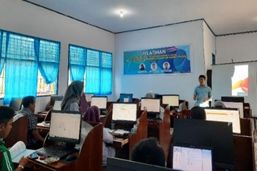
The dominance of JavaScript in the modern web development ecosystem requires backend developers to master non-blocking programming paradigms to build scalable systems. However, the complexity of asynchronous logic often poses a cognitive barrier for novice developers in managing intensive I/O operations. This Community Service (PkM) activity aims to accelerate the technical competencies of student participants in the 2024 Bangkit Academy Batch 1 Program by strengthening Asynchronous JavaScript concepts on the server side. The implementation method was conducted online nationwide through expert-led instruction sessions, code reviews, and the implementation of callbacks, promises, and async-await within the Node.js environment. The results of the activity indicate a significant increase in participants' capabilities to design efficient and low-latency server workflows. Project-based evaluations prove that a profound understanding of asynchronous logic successfully enhances code quality and participants' technical readiness to face application development challenges at global industry standards.
Alman, T. (2022). Node.js Design Patterns: Design and implement production-grade Node.js applications using proven patterns and techniques (3rd ed.). Packt Publishing.
Biemans, H. J., & van Mil, M. H. (2021). Learning to program in higher education: A review of modern pedagogy for asynchronous logic. Computer Science Education, 31(2), 215–240. https://doi.org/10.1080/08993408.2020.1871492
Cantelon, M., Harter, M., Holowaychuk, T., & Rajlich, N. (2017). Node.js in Action (2nd ed.). Manning Publications.
Dahl, R. (2018). Original Node.js Presentation: The development of non-blocking I/O. Joyent Inc.
Ecma International. (2023). ECMAScript 2023 Language Specification (14th ed.). https://www.ecma-international.org/publications-and-standards/standards/ecma-262/
Haverbeke, M. (2024). Eloquent JavaScript: A Modern Introduction to Programming (4th ed.). No Starch Press.
Kurniawan, A., & Saputra, R. (2022). Analisis performa arsitektur event-driven pada server-side JavaScript menggunakan Node.js. Jurnal Pengembangan Teknologi Informasi dan Ilmu Komputer, 6(11), 5122–5130.
Lanthaler, M., & Guetl, C. (2019). Model-driven development of scalable backend services using Node.js. Journal of Web Engineering, 18(1), 1–32. https://doi.org/10.13052/jwe1540-9589.1811
OpenJS Foundation. (2024). Node.js v20.x Documentation: Asynchronous flow control. https://nodejs.org/docs/latest-v20.x/api/
Parsons, D., & MacCallum, K. (2021). Agile mentoring in online software engineering education: Lessons from national training programs. Journal of Systems and Software, 175, 110912. https://doi.org/10.1016/j.jss.2021.110912
Pratama, M. A., & Ramadhani, S. (2023). Implementasi RESTful API menggunakan Express.js untuk mendukung skalabilitas sistem informasi mahasiswa. Jurnal Informatika dan Rekayasa Perangkat Lunak, 5(2), 145–155.
Resig, J., Bibeault, B., & Maras, J. (2016). Secrets of the JavaScript Ninja (2nd ed.). Manning Publications.
Subramanian, V. (2018). Modern JavaScript for the Impatient. Addison-Wesley Professional.
Teixeira, P. (2012). Professional Node.js: Building Highly Scalable HTTP APIs. John Wiley & Sons.
V8 Project. (2024). V8 JavaScript Engine: High-performance JavaScript and WebAssembly implementation. Google Open Source. https://v8.dev/
Copyright (c) 2025 Marzuki Pilliang, Afifah Khaerani A

This work is licensed under a Creative Commons Attribution-NonCommercial-ShareAlike 4.0 International License.